Archives of Translation Methods & Processes - The French Translator
27 October 2026
Global content volume is exploding. More formats, more channels, more variants, more languages, and more demand for personalization. Yet budgets and teams are not growing at the same pace. That is the core paradox of the moment: the near-infinite potential of content does not create an infinite capacity to localize it. In that environment, the […]
Read the article
20 October 2026
In many organizations, the first response to localization pressure is still the same: cut costs, renegotiate rates, reduce volumes, or delay certain launches. That reaction is understandable. But it often misses the real issue. Today, the main bottleneck is not just budget. It is operational. The challenge is no longer simply to spend less, but […]
Read the article
6 October 2026
AI was supposed to make multilingual content production easier. In practice, many teams are seeing something else: more output to review, more back-and-forth, more uncertainty about quality, and often more coordination than before. That is where AI fatigue in localization begins. It is not only about cultural resistance or general weariness with new technology. In […]
Read the article
29 September 2026
Generative AI is impressive for its speed, fluency, and ability to produce text at scale. But localization makes it very clear where that promise starts to break down. Why? Because localization is not just about converting words from one language into another. It requires teams to interpret intent, handle implication, account for product context, culture, […]
Read the article
16 September 2026
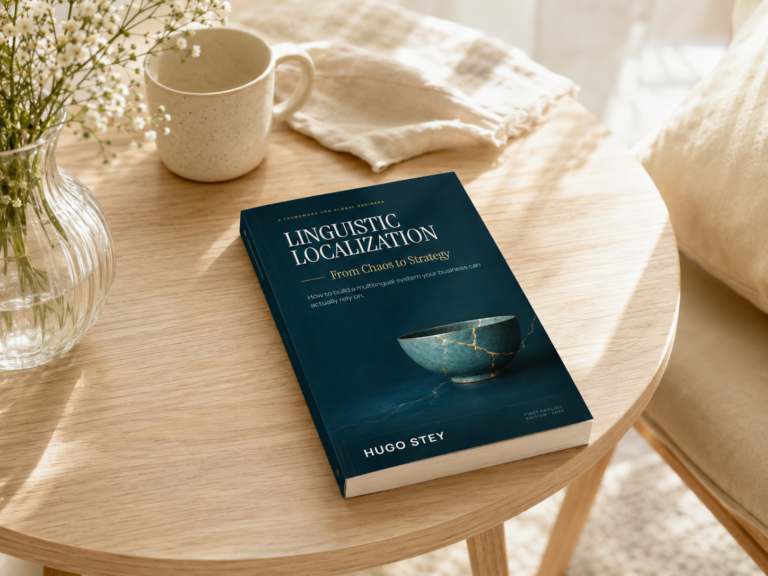
The English edition of my book is now available. It is called Linguistic Localization: From Chaos to Strategy and, although it clearly grew out of the original French book, I do not consider it a simple translation. When I started working on the English edition, I could have taken the original text chapter by chapter […]
Read the article
15 September 2026
When teams talk about localization, many still think in terms of text volume. The longer the content, the more strategic it seems. By contrast, a three-word UI string can look minor, almost administrative. That is a common mistake. In digital products, the shortest pieces of content often carry the most critical decisions: click, confirm, cancel, […]
Read the article
8 September 2026
AI has changed the conversation around localization. The question is no longer simply should you use it? but under what conditions does it actually deliver quality? Many teams start by comparing models, prompts, or expected productivity gains. That is useful, but it is not the right starting point. In practice, the real prerequisite for AI […]
Read the article
1 September 2026
When a multilingual AI pilot underperforms, the first instinct is often to blame the model, the prompt, or the output quality. In many cases, though, the real issue starts much earlier: with how the content itself was prepared. AI does not compensate for poorly prepared content. It does not automatically fix unstable terminology, inconsistent structure, […]
Read the article
28 July 2026
For a long time, linguistic quality was treated as a final verification step. Teams created content, translated it, and then reviewed it before publishing. That model could work in slower production cycles, with limited volumes and relatively stable deliverables. That is no longer the reality. Today, teams manage serial, multimodal, and continuously updated content: product […]
Read the article
21 July 2026
For a long time, quality in translation and localization was assessed through a relatively simple lens: grammar, syntax, terminology, spelling, and fluency. Those criteria still matter. But they are no longer enough. In environments where content moves across product, marketing, support, legal, audiovisual, gaming, documentation, and interfaces, a more important question has emerged: does this […]
Read the article
14 July 2026
A seasonal campaign can be perfectly written and still miss the mark. The reason is simple: in international marketing, translating a holiday or event does not guarantee that the message will feel relevant or resonate locally. National calendars, religious traditions, commercial habits, cultural sensitivities, and seasonal differences all shape how audiences respond. The same marketing […]
Read the article
5 May 2026
The promise is appealing: deploy AI in localization to increase speed, reduce costs, and handle larger volumes. Yet when a project underdelivers, the diagnosis is often too quick: blame the technology, the model quality, or the limits of automation. In practice, the root causes usually lie elsewhere. In localization, challenges stem less from the tools […]
Read the article
Next step
A localization question to clarify?
Let’s discuss your context, priorities, and the next useful decision.