
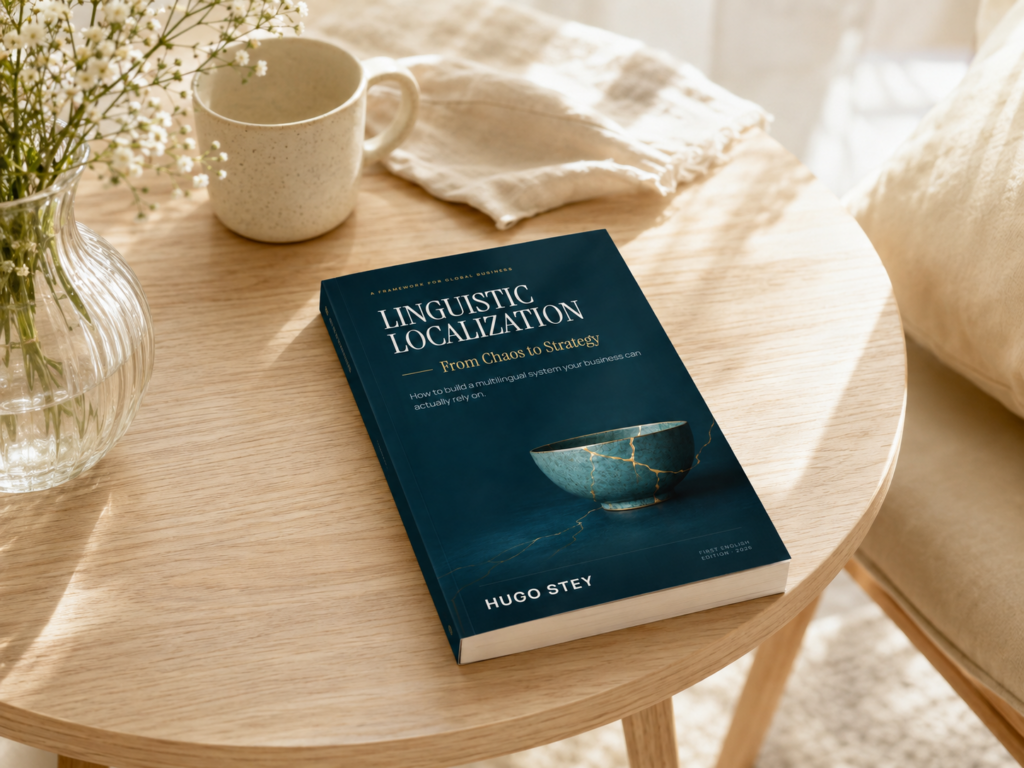

The English edition of my book is now available.
It is called Linguistic Localization: From Chaos to Strategy and, although it clearly grew out of the original French book, I do not consider it a simple translation.
When I started working on the English edition, I could have taken the original text chapter by chapter and adapted it into English. But by then, my thinking had evolved. The market had evolved too. Artificial intelligence had become a much more practical part of localization operations, governance had become increasingly important, and several ideas that were only introduced briefly in the first edition deserved much more space.
So I chose a different approach: to treat the book itself as a system that needed to evolve, rather than as a text that simply needed to be translated.
The result is a restructured, expanded, and more ambitious English edition. It keeps the core philosophy of the French book while taking several of its ideas significantly further.
The same starting point: translation is rarely the real problem
The central argument remains unchanged.
When localization is not working well inside an organization, the problem is rarely translation alone.
More often, the problem lies around it: who makes decisions, who approves what, how source content is prepared, what level of quality is actually required, how tools interact, how linguistic resources are used, and, ultimately, who owns the system as a whole.
An organization can work with excellent translators and still deliver an inconsistent multilingual experience.
It can have a modern TMS, translation memories, terminology databases, and access to the latest AI models while continuing to lose time over the same recurring decisions.
It can even automate more, and simply automate its own inconsistencies faster.
That is why the English edition develops one of the ideas already present in the French book much more explicitly:
Localization should be treated as an organizational capability, not as a succession of translation projects.
From localization strategy to a localization operating model
This is probably the most important evolution between the two editions.
The original French version was primarily about helping organizations move from fragmented localization practices toward a more structured and strategic approach.
The English edition extends that idea into what I describe as a localization operating model: the way an organization makes, applies, governs, and improves multilingual decisions over time.
The question is no longer simply:
How can we manage translation better?
It becomes:
How should our organization operate if we want to deliver a reliable multilingual experience as we scale?
That shift in perspective opens the door to issues that go well beyond linguistic production: ownership, governance, workflow design, prioritization, risk, technology, collaboration with product and marketing teams, procurement, and relationships with external partners.
Localization becomes less about managing files and more about managing a system.
What has been added or expanded
The English edition does not simply reproduce the original content in another language. Several topics have been significantly expanded, while others have become central pillars of the new structure.
Among the most important developments:
- Localization governance plays a much larger role—not as an additional layer of administration, but as a way to make decisions faster, more consistent, and more reusable.
- Risk-based localization is developed as an alternative to workflows in which every piece of content receives the same level of control. Not every word carries the same business risk, and not every piece of content justifies the same amount of human effort.
- Quality is treated as a business decision. The goal is no longer to pursue an abstract idea of “maximum quality,” but to define the right level of quality for the content, its audience, its business impact, and the consequences of getting it wrong.
- AI and automation are integrated much more deeply into the operating model. The question is not whether AI can replace a particular task, but how it can become part of a system that preserves context, rules, human decisions, and the learning generated through review.
- Localization as product infrastructure is developed more explicitly, particularly for SaaS companies and digital products.
- Global content operations receive greater attention. A multilingual website, for example, is not a website that gets translated once; it is a continuous international content operation that must be maintained over time.
- The new edition also connects localization more directly to time-to-market, brand consistency, operational efficiency, risk management, and an organization’s ability to expand across markets.
Some of these ideas were already present in the French edition. In the English edition, they become much more clearly part of the overall model.
A different role for artificial intelligence
Reworking the book also meant revisiting the role of AI.
But I deliberately avoided turning this into a book about “AI in translation.”
The technology is evolving too quickly for a list of tools or models to remain useful for very long. The more important questions are structural.
An impressive demonstration does not mean a workflow is ready for production.
Producing a good translation on a handful of segments does not tell you whether terminology is being used properly, whether human corrections are retained, whether high-risk content is identified, which models teams are allowed to use, which data can be sent to them, or where human review still matters.
In other words:
AI does not remove the need for governance. It makes that need more visible.
As content production becomes easier to automate, value shifts toward defining the right rules, connecting the right resources, preserving organizational learning, and knowing when human expertise is actually required.
The goal is therefore not “AI-first localization.”
The goal is a localization system in which automation eventually becomes almost invisible: a quiet infrastructure that supports good decisions rather than trying to replace them.
A book designed more explicitly around implementation
The structure of the English edition has also evolved.
After establishing the foundations—maturity, ownership, governance, quality, and risk—the book moves progressively into the operating model itself: workflows, planning, language partners, technology, AI, and automation.
The final part then applies the model to three particularly common environments:
websites, digital products and SaaS, and international marketing.
This matters because there is no universal localization workflow.
The principles may be consistent, but the way they are applied depends on the type of content, the level of risk, the speed required, the teams involved, and the role that content plays in the user experience.
The book ends with a very practical question:
What can you actually change in the first 90 days?
The aim is not to redesign an entire organization before making progress. It is to identify the structural decisions that can begin moving localization from a reactive activity toward a managed capability.
Practical resources that can evolve separately from the book
As with the French edition, I also decided not to freeze every practical tool inside the printed book.
The English edition therefore comes with a separate set of companion resources, including a localization maturity assessment, a minimum governance framework, a quality/speed/cost trade-off matrix, a localization readiness checklist, an essential localization brief, an executive guide for discussing localization with leadership, a standard workflow model, and a content-type requirements framework.
These resources are available separately on my website.
That separation is intentional.
A book should be able to establish durable principles. Practical tools should be able to evolve.
Keeping them outside the printed edition means I can continue refining them as practices, technologies, and organizational needs change.
Why publish an English edition?
There was also a simpler reason for creating this new version.
The problems explored in the book are not specific to France.
An American SaaS company, a German manufacturer, a Japanese group, or a French scale-up expanding internationally will eventually face many of the same questions:
Who owns localization?
How do we maintain consistency?
How far should we automate?
Where should human expertise be concentrated?
How do we know whether our localization system can actually scale?
Publishing the book in English makes it possible to bring that discussion to a much broader audience and to engage more directly with the international localization ecosystem.
And if I was going to revisit the entire book, it seemed much more useful to improve it than simply reproduce it.
From chaos to strategy
The philosophy behind the title has not changed.
The “chaos” in localization is rarely spectacular.
It usually looks like a collection of small frictions that have gradually become normal: an Excel file sent by email, three different translations of the same product term, a launch waiting for one reviewer, a market accidentally left out of a release, the same correction being made again and again, or a team that is not entirely sure who is supposed to make the final decision.
Individually, these problems look operational.
Together, they reveal something more fundamental:
the absence of a shared system for managing multilingual content and decisions.
Linguistic Localization: From Chaos to Strategy was written to help organizations build that system.
Not a perfect system.
A system that is governed, coherent, aligned with business priorities, and able to learn as the organization grows.
Linguistic Localization: From Chaos to Strategy
How to build a multilingual system your business can actually rely on.
The first English edition is now available on Amazon.
A question after reading?