Resources

Analysis and tools for better multilingual decisions.

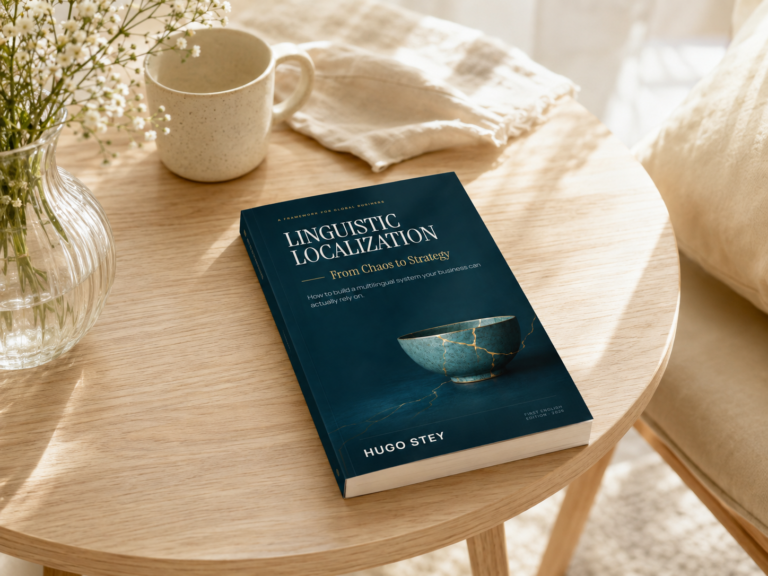
Articles, case studies, Lokal, newsletter, book, and the 2026 report are grouped as a practical expertise center for localization leaders.

Read to understand. Equip to act. Build to last.

04

Case studies

Concrete decision stories showing how localization governance changes quality, timing, and control.

Explore cases
06

Podcast

Conversations about localization decisions, language work, AI, and the people shaping international communication.

Explore the podcast

15 September 2026

App Localization Is Not Microcopy: It’s a Layer of Product Quality

When teams talk about localization, many still think in terms of text volume. The longer the content, the more strategic it seems. By contrast, a three-word UI string can look minor, almost administrative. That is a common mistake. In digital products, the shortest pieces of content often carry the most critical decisions: click, confirm, cancel, […]

Read the article

8 September 2026

AI in Localization: Without Context, You’re Mostly Automating Errors

AI has changed the conversation around localization. The question is no longer simply should you use it? but under what conditions does it actually deliver quality? Many teams start by comparing models, prompts, or expected productivity gains. That is useful, but it is not the right starting point. In practice, the real prerequisite for AI […]

Read the article

18 August 2026

The KPIs That Really Matter for a Multilingual AI POC

A multilingual AI proof of concept rarely fails because the model cannot generate text. More often, it fails because the company is measuring the wrong things. If you only track generation speed, cost per word, or a few “before and after” examples, you end up with a showcase, not a decision framework. A serious POC […]

Read the article

4 August 2026

Why AI Makes Errors More Fluent: The New Hidden Cost of Linguistic QA

One of the most common misunderstandings about AI in localization is simple: if the text sounds more natural, human effort must go down. In practice, it is not that straightforward. Yes, generative models often produce more fluent output than older systems. Yes, they can speed up part of the production process. But that fluency creates […]

Read the article

28 July 2026

Why linguistic quality can no longer be checked at the end

For a long time, linguistic quality was treated as a final verification step. Teams created content, translated it, and then reviewed it before publishing. That model could work in slower production cycles, with limited volumes and relatively stable deliverables. That is no longer the reality. Today, teams manage serial, multimodal, and continuously updated content: product […]

Read the article

21 July 2026

Quality Can No Longer Be Evaluated Only Through Linguistic Metrics

For a long time, quality in translation and localization was assessed through a relatively simple lens: grammar, syntax, terminology, spelling, and fluency. Those criteria still matter. But they are no longer enough. In environments where content moves across product, marketing, support, legal, audiovisual, gaming, documentation, and interfaces, a more important question has emerged: does this […]

Read the article

14 July 2026

Localizing Holidays and Events: When Translation Is No Longer Enough

A seasonal campaign can be perfectly written and still miss the mark. The reason is simple: in international marketing, translating a holiday or event does not guarantee that the message will feel relevant or resonate locally. National calendars, religious traditions, commercial habits, cultural sensitivities, and seasonal differences all shape how audiences respond. The same marketing […]

Read the article

7 July 2026

Localization and User Experience: Why Their Convergence Is Inevitable

For a long time, localization was treated as the final layer: design the product, write the content, then translate it. That model no longer works once a product serves multiple markets, languages, and usage contexts. The reason is simple: language is not decoration around the user experience. It is a functional part of the experience […]

Read the article

Next step

A localization question to clarify?

Let’s discuss your context, priorities, and the next useful decision.

Discuss your priorities